



You hear that little ping. Your shoulders tense up just a tiny bit. Your hand moves toward your phone before your brain even decides to check it. By the time you have unlocked the screen, you are already mildly anxious about whatever is waiting on the other side.
Sound familiar?
I personally noticed this in myself a few months back. I was sitting in a quiet room, completely relaxed, and a notification ping went off across the room. My entire body reacted before I even thought about what the sound meant. That moment honestly disturbed me. Because I realized my nervous system was reacting to a sound the same way it would react to a real threat.
Notification sound anxiety phone addiction is not in your imagination. It is a documented psychological response that has been carefully engineered by the people who designed your phone. And once you understand how it works, you cannot unsee it.
TOC
- 1 The Sound Itself Was Designed to Hijack Your Attention
- 2 Why Phone Notifications Trigger Stress Response
- 3 The Phantom Vibration Syndrome Smartphone Users All Know
- 4 Dopamine Reaction to Notification Beep Is Why You Cannot Stop Checking
- 5 What This Actually Costs You Over Time
- 6 How to Reduce Notification Anxiety Daily Starting Today
- 7 What Reclaiming Your Attention Actually Feels Like
The Sound Itself Was Designed to Hijack Your Attention
To start with, let us be clear about something. Notification sounds are not random.
The little chimes, pings and beeps that smartphones use are designed by sound engineers and behavioral psychologists who specifically study what auditory frequencies create the strongest involuntary attention response in the human brain. These sounds are tested, refined and selected for one specific purpose, to make sure you cannot ignore them even if you try.
The frequencies used in most notification sounds sit in a range that the human ear is naturally sensitive to. They are short, sharp and slightly rising in tone, which mimics the acoustic profile of an urgent alert signal that humans evolved to respond to in dangerous situations. When you hear that ping, a small part of your nervous system briefly thinks something might be wrong.
In other words, your brain is being tricked into a low level fight or flight response several times every single day. By design.
Why Phone Notifications Trigger Stress Response
This is where it gets really interesting and a bit alarming.
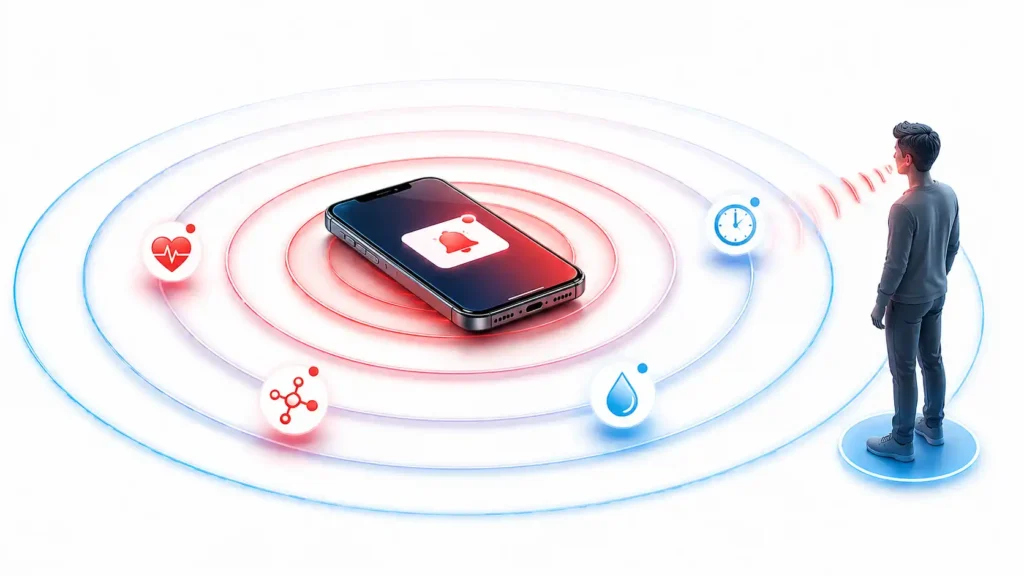
Why phone notifications trigger stress response is something researchers in behavioral psychology have studied extensively. When you hear a notification sound, your body releases a small spike of cortisol, the stress hormone. At the same time, your brain releases a small hit of dopamine in anticipation of whatever the notification might contain.
So you are simultaneously getting a stress signal and a reward signal. Both at the same time. Several times a day. Hour after hour. Day after day.
Over time, this conditions your nervous system into a state of low grade chronic anxiety. You start feeling slightly on edge even when no notifications are coming in. Because your body is now constantly braced for the next ping.
I think this is honestly one of the most important things any smartphone user should understand. The exhaustion you feel at the end of a normal workday is not just from work. A meaningful chunk of it is from your nervous system being repeatedly activated by notification sounds throughout the day, often without you even realizing it.
The Phantom Vibration Syndrome Smartphone Users All Know
Here is something almost everyone has experienced but rarely talks about.
You feel your phone vibrate in your pocket. You reach for it. There is no notification. The vibration was never real. Your brain just imagined it.
Phantom vibration syndrome smartphone users experience daily is a real and documented phenomenon. Studies have found that anywhere between 70 to 90 percent of regular smartphone users experience phantom vibrations or phantom notifications regularly.
Your brain has become so conditioned to expect notifications that it occasionally generates the sensation of receiving one when nothing has actually happened.
To be honest, when I first read about this, I dismissed it. Then I started paying attention to my own behavior and realized I was doing it three or four times every single day. Reaching for a phone that had not made a sound. Checking a screen that had no new alerts. The reflex was completely automatic and completely disconnected from reality.
That is what conditioning at a nervous system level looks like in practice.
Dopamine Reaction to Notification Beep Is Why You Cannot Stop Checking
To be precise, here is exactly what is happening neurologically every time you hear that ping.
Dopamine reaction to notification beep follows a pattern that behavioral psychologists call variable reward conditioning. Sometimes the notification is something exciting, a message from someone you care about, a job email you were waiting for, a payment confirmation. Sometimes it is something boring, a promotional spam alert, a routine app update, an unimportant news headline.
Because you cannot predict in advance which kind it will be, your brain releases dopamine every time you hear the ping in anticipation of finding out. This is exactly the same psychological mechanism that makes slot machines so addictive. Variable rewards are far more powerful than predictable ones.
As a result, even though most notifications turn out to be unimportant, the few that turn out to be exciting are enough to keep your brain reaching for that phone over and over again. Day by day, the pattern reinforces itself.
By no means is this an accident. The mobile apps installed on your phone are specifically designed to trigger this exact response. Every red badge, every push notification, every ping is engineered to keep you checking compulsively.
What This Actually Costs You Over Time
To wrap this part up before we get to solutions, I want to name what this is actually costing you.
Hours of focus, drained slowly throughout each day. Sleep quality, disrupted because you cannot resist checking right before bed. Genuine presence with people you love, broken every time your phone makes a sound at the dinner table. A nervous system that is in mild but constant state of alert, even on weekends and holidays.
Notification sound anxiety phone addiction is not just an annoying habit. It is a slow steady tax on your mental energy, your relationships and your peace of mind.
How to Reduce Notification Anxiety Daily Starting Today
To be honest, I have personally tried many of these and the difference in how I feel by evening is genuinely noticeable. So let me share what actually works.
How to reduce notification anxiety daily starts with one simple decision. Most apps on your phone do not need to make a sound. Go to your Settings, then Notifications, and ruthlessly turn off sound and vibration for every app that is not essential. Banking apps, work email and direct messages from real humans can stay on. Promotional apps, social media, news apps and games should be silenced completely.
Second, switch your phone to greyscale mode at night. Most phones have a built in option for this in the accessibility settings. When the screen is in black and white, the visual reward of checking notifications becomes significantly weaker, and your urge to reach for the phone naturally reduces.
Third, try not silent mode but actual silent mode for at least one hour every single day. Phone face down. Sound completely off. No vibration. Nothing. Even one hour daily of true disconnection from the notification cycle starts to recalibrate your nervous system surprisingly fast.
Fourth, never sleep with your phone within arm’s reach if you can avoid it. The first and last thing your nervous system processes every day should not be a notification ping. Place your phone across the room or in another room entirely if you can manage it.
Finally, consider changing your default notification sound to something soft and calm rather than the sharp default ping. A softer sound triggers a noticeably weaker stress response while still alerting you to important messages. It is a tiny change with surprisingly real impact.
What Reclaiming Your Attention Actually Feels Like
To wrap up, notification sound anxiety phone addiction is real, it is engineered into your phone by design and it is silently costing you more than you realize every single day.
The good news is that your nervous system is highly adaptable. Within just a few weeks of meaningfully reducing notification exposure, most people report feeling calmer, sleeping better and having significantly more capacity to focus on what actually matters in their day.
I genuinely believe this is one of the simplest yet most underrated changes anyone with a smartphone can make in 2026. You do not have to abandon technology. You just have to stop letting it ping you into a state of low grade anxiety from morning until night.
Your phone works for you. Not the other way around. And that one shift in how you set up your notifications can change how the rest of your day feels.

[ Author ] – Safdar Khurshid researches and evaluates consumer electronic gadgets, including smartphones, laptops, accessories, and everyday tech products, with a strong focus on long term usability, real world performance and buying mistakes people often regret later. His work is centered on helping readers understand trade offs clearly, so they know not just what to buy but also what to avoid.