

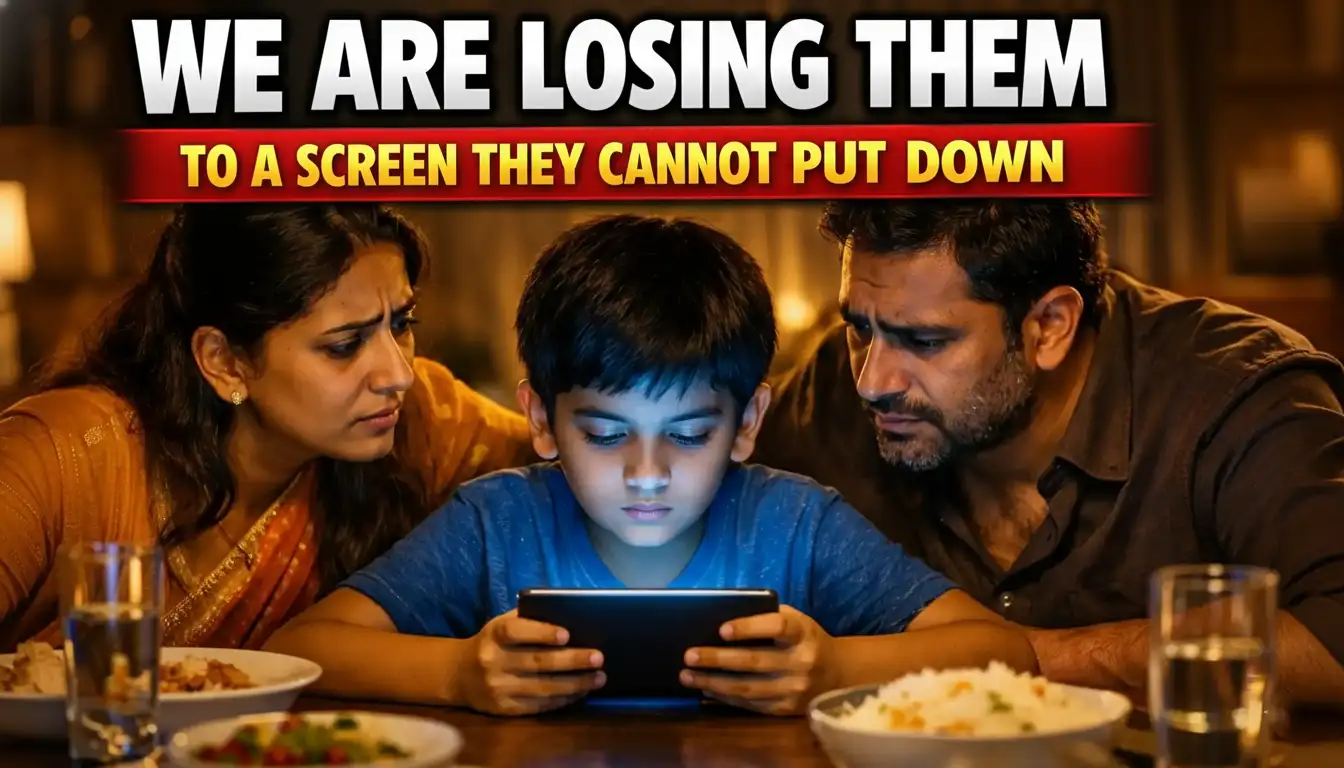

A seven year old child sits in the back seat of a car. Her parents ask her to read the time on the analog clock on the dashboard. She stares at it blankly. She genuinely does not know how.
A fourteen year old boy is asked to give directions to a relative visiting his own neighborhood. He immediately reaches for his phone. Without Google Maps, he simply cannot do it.
These are not rare stories. These are happening in homes and schools across India every single day right now. And honestly, i find this more unsettling than almost any technology topic i have written about. Because this one is not about adults making choices. This is about children who never got the chance to develop certain skills at all.
Screen time effects on child brain development are no longer a future warning that researchers give at conferences. They are visible right now, in this generation, in real time. And we are all watching it happen without quite knowing what to do about it.
TOC
What Is Actually Disappearing and Why It Matters
To start with, let me be clear about something important. This is not a lecture about too much screen time. This is a genuine observation about specific cognitive skills that are quietly disappearing from an entire generation of children who are growing up on screens.
Since children addicted to phones and tablets in India spend an average of 4 to 6 hours daily on screens from as early as age 2, their brains are developing in a fundamentally different environment than any previous generation. The brain is not broken. It is simply adapting to the inputs it receives most. And right now, those inputs are almost entirely passive, visual and instantly rewarding.
The problem is that many essential cognitive skills only develop through specific kinds of friction. Boredom. Waiting. Getting lost and finding your way back. Trying to read something that does not move or animate. Sitting with a problem that has no instant answer.
When those experiences are replaced entirely by screens from an early age, the brain simply does not build those particular pathways. Not because the child is less intelligent. But because, by nature, the brain only develops what it regularly uses.
The Specific Skills That Are Going Away
I want to talk about this in concrete terms because I think abstract warnings do not hit hard enough.
Reading analog clocks is one example that, at first glance, sounds trivial. But actually it requires spatial reasoning, the ability to read a non-linear display and a form of mental translation that builds foundational mathematical thinking. Kids who cannot function without smartphones have generally never needed to develop this skill because their phone always shows the time in digital format instantly.
Giving directions without Maps is another one. Before Google Maps, navigating a city required building a mental spatial map, remembering landmarks, sequencing steps and holding a route in working memory.
These are genuine executive function skills. Today, most teenagers in Indian cities cannot give you directions to a place they have visited dozens of times. Because they have always just followed a blue dot. That mental mapping ability is disappearing from an entire generation without anyone noticing.
Sitting in silence without stimulation is perhaps the most alarming one. The ability to simply sit with your own thoughts, to tolerate boredom and to generate your own internal entertainment is a foundational mental skill. It is connected to creativity, emotional regulation and the ability to focus for extended periods.
Children who grow up on screens, where every moment of potential boredom is immediately filled with content, often genuinely struggle to sit quietly for even five minutes. In practice, this makes sustained reading, deep studying and focused work significantly harder for them as they grow older.
The Growing Up on Screens Generation Impact in India
To be precise, India is facing this at a scale that is honestly difficult to fully absorb.
Since affordable smartphones arrived in India between 2016 and 2019, there is now an entire generation of children, currently aged 6 to 12, who have essentially never known life without a screen. They are the first generation in human history to grow up with on demand digital stimulation available from infancy.
The growing up on screens generation impact here is different from Western countries in one important way. In many Indian households, a screen is used as a primary childcare tool from a very early age because parents are working and affordable childcare is limited.
This is not a judgment. It is a real circumstance that millions of Indian families face. But the outcome is that Indian children are often getting significantly more unsupervised screen time at younger ages than their peers in other countries.
I personally know families where children as young as three are watching YouTube for four or five hours a day. And i understand why it happens. A screen is the only thing that keeps a toddler calm while a parent works or cooks or manages the household.
But sooner or later the cognitive cost of that becomes visible. And by the time it is visible, years of critical developmental window have already passed.
This Is Not About Blame
To be fair, i want to say this clearly. This article is not written to make parents feel guilty. It is not written to judge anyone. Every parent is doing their best under real circumstances.
But I do think there is value in naming what is happening clearly and honestly. Because the first step to addressing any problem is simply seeing it without looking away.
The cognitive skills disappearing in the digital generation are not going to come back on their own. They require deliberate effort, specific experiences and, most importantly, time away from screens doing things that are genuinely hard and genuinely boring.
Reading physical books. Playing outside without a structured activity. Getting lost on purpose and finding the way back. Having a conversation without a phone in hand. Waiting without filling the wait with content.
These are not nostalgic luxuries. They are developmental necessities.
What Actually Works

To be honest, most advice on this topic sounds completely disconnected from real Indian family life. So let me share what actually works in practice, not just in theory.
First, replace one screen session daily with a specific offline activity. Not just “go play outside” because that is too vague and most kids will simply come back inside in five minutes. Instead, give them something specific. A physical puzzle. A drawing challenge. A simple cooking task in the kitchen with you. Something with a clear start and finish that their hands are busy with.
Second, bring back boredom on purpose. I know that sounds strange. But actually, boredom is where creativity lives. When a child has nothing to do and no screen to reach for, their brain starts generating its own entertainment. That internal generation is exactly the cognitive muscle that screen time replaces. Even 20 minutes of enforced boredom daily, over time, makes a visible difference.
Third, make the dinner table a phone free zone without exception. Not just for kids. For everyone including parents. Since children learn by watching what adults do far more than by listening to what adults say, this one change sends a more powerful message than any screen time lecture ever could.
Fourth, instead of fighting against screens completely, which is both impractical and exhausting, choose active screen use over passive screen use. A child building something in Minecraft is using spatial reasoning and creativity. A child watching unboxing videos for two hours is doing neither. The type of screen activity matters just as much as the amount of time spent on it.
Finally, and most importantly, do not wait until the problem is obvious. The best time to build healthy screen habits in a child is before the dependency sets in. The second best time is right now, today, with whatever small change you can realistically make in your home this week.
Little by little, day by day, these small shifts genuinely add up to something meaningful for your child’s developing brain.
Wrap Up
Everyone knows that screen time effects on child brain development are real, they are measurable and they are already visible in the generation growing up around us right now.
The good news is that none of this is permanent. The brain stays plastic far longer than most people realize. The skills that are fading can still be rebuilt with the right inputs and the right environment. But that process requires deliberate effort and it requires starting today, not when the problem becomes impossible to ignore.
The solutions shared above are not complicated. They do not require expensive tools or perfect parenting. They just require consistency and the willingness to make small uncomfortable changes in a household that has gotten very comfortable with screens as the default answer to everything.
I genuinely believe that awareness is always the first real step. And the fact that you read this article all the way to this point tells me you already care enough to do something about it. That is honestly more than most people are willing to do. And for your child’s brain, that difference matters more than you know.

[ Author ] – Safdar Khurshid researches and evaluates consumer electronic gadgets, including smartphones, laptops, accessories, and everyday tech products, with a strong focus on long term usability, real world performance and buying mistakes people often regret later. His work is centered on helping readers understand trade offs clearly, so they know not just what to buy but also what to avoid.