



Think about the last time you typed something at 2am when you could not sleep. The words came out slower than usual. You deleted and retyped sentences more than once. The things you wrote were heavier, darker, more honest than anything you would say out loud in the daytime.
You thought nobody saw that. Your keyboard app did. Every single word of it.
Keyboard app tracking your mental health secretly is not a future concern or a conspiracy theory. It is a documented, patent filed, actively researched reality that has been quietly building a psychological profile of your mental state for years, one keystroke at a time.
I personally found this deeply uncomfortable to write about. Because i realized halfway through my research that everything i have ever typed into Gboard or SwiftKey, including my worst nights, my most anxious messages and my most vulnerable conversations, was being analyzed in ways I never consented to and never imagined.
TOC
What Your Keyboard Is Actually Paying Attention To
To start with, most people think a keyboard is just a tool. You tap letters, words appear. That is it.
Actually, your keyboard app is paying attention to far more than the words themselves. Since every keystroke generates data, keyboard apps have access to an extraordinarily detailed behavioral dataset about you that builds up over months and years of daily use.
Here is what they specifically track. Your typing speed and how it changes throughout the day. The length of time you pause between words or sentences. How often you delete and retype something. The specific words and phrases you use most frequently.
How your autocorrect patterns shift over time. Whether your sentences get shorter and more fragmented. Whether your word choices become more negative, more self referential or more hopeless in tone.
Individually, each of these data points seems harmless. Together, they form something that researchers in behavioral psychology call a typing pattern profile and it turns out that typing patterns reveal depression and anxiety with a surprisingly high degree of accuracy.
The Gboard SwiftKey Emotional Detection Patent Is Real
Here is the part that I think will genuinely stop you mid scroll.
Gboard SwiftKey emotional detection patent is not a rumor. Both Google and Microsoft, the companies behind Gboard and SwiftKey respectively, have filed documented patents related to detecting emotional states through typing behavior.
These patents describe systems that analyze keystroke timing, word selection and typing rhythm to infer a user’s emotional condition in real time.
In other words, the keyboard sitting on your phone right now has the documented technical ability to detect whether you are anxious, sad, stressed or depressed based entirely on how you type, not what you type, but how.
I think this is one of those moments where most people read something and immediately think that cannot be real. But it is. The patents are publicly available. The research behind them is published. This is not speculation.
How Keyboard Psychological Profile of Users Actually Gets Built
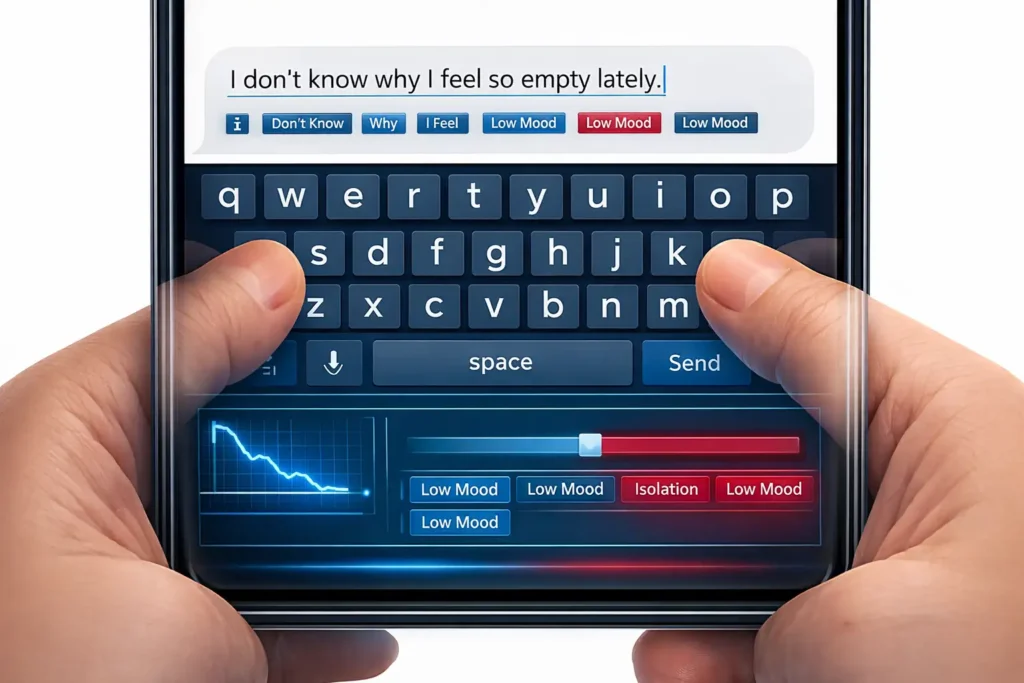
To be precise, here is how this works over time in practice.
When you first install a keyboard app, it starts learning your language patterns. Over weeks and months it builds what is essentially a keyboard psychological profile of users based on their individual typing habits. This profile includes your vocabulary preferences, your sentence structure tendencies and your emotional language patterns.
As a result, by the time you have used a keyboard app for a year or two, it has a remarkably detailed map of your psychological baseline. It knows what your normal looks like. And because it knows your normal, it also knows when you deviate from it.
A sudden increase in negative word usage. A sharp drop in typing speed. More deletions and corrections than usual. Shorter, more fragmented sentences late at night. Each of these deviations from your personal baseline is a signal that something has shifted emotionally.
Researchers at universities across the world have demonstrated that these signals can predict the onset of a depressive episode before the person themselves has consciously recognized what they are feeling. Your keyboard, in many cases, knows you are depressed before you do.
What Happens to That Data
This is honestly the question that should matter most to you.
How keyboard apps collect your personal data and what they do with it afterward is, to be fair, not always clearly disclosed. Most keyboard apps collect typing data under broad privacy policies that describe it vaguely as improving user experience or personalizing suggestions.
In practice, this data can be used for targeted advertising based on your inferred emotional state. It can be shared with third party data brokers. It can be used to train machine learning models that detect mental health conditions at population scale.
And since most users never read privacy policies in detail, this collection happens without any meaningful awareness or consent from the people whose most vulnerable moments are being catalogued.
I think about all the times I typed something desperate or sad or anxious into a messaging app. All those keystrokes went somewhere. They are sitting in a database somewhere contributing to a profile of me that I never agreed to create. And honestly that thought is something I cannot fully shake.
What You Can Actually Do About This
To be honest, you cannot completely opt out of this as long as you use a smartphone. But you can reduce your exposure meaningfully.
First, check your keyboard app permissions right now. Go to Settings, then Apps, then your keyboard app and check what permissions it has. Specifically look for network access. A keyboard app that has internet permission can send your typing data to external servers in real time. Revoking internet access from your keyboard app is the single most effective step you can take immediately.
Second, consider switching to an open source keyboard like OpenBoard which is available on Android. Unlike Gboard or SwiftKey, OpenBoard does not send any data to external servers by nature. It works entirely offline and its code is publicly available for anyone to inspect.
Third, for your most private and vulnerable conversations, use the incognito keyboard mode that most keyboard apps offer. This mode does not learn from your typing and does not store what you write. It is not perfect but it is meaningfully better than typing in standard mode during your most honest moments.
Finally, and most importantly, simply be aware. Keyboard app tracking your mental health secretly is real and it is ongoing. That awareness alone changes how you interact with your device and how much of your most private self you hand over to an app without thinking.
What This Really Means for All of Us
To wrap up, I want to end this with something that goes beyond privacy settings and technical fixes.
The fact that keyboard psychological profile data exists means that somewhere right now, a database knows things about the mental state of millions of Indians that those people have never told anyone. Their worst nights. Their most anxious mornings. Their most honest words typed in the dark.
That is not just a privacy issue. It is a deeply human one.
Your phone knows you better than you think. And from now on, every time you pick it up to type something real, something heavy, something true, i think it is worth remembering that you are not just talking to the person on the other end of that message.
You are also talking to the app between your fingers and theirs.

[ Author ] – Safdar Khurshid researches and evaluates consumer electronic gadgets, including smartphones, laptops, accessories, and everyday tech products, with a strong focus on long term usability, real world performance and buying mistakes people often regret later. His work is centered on helping readers understand trade offs clearly, so they know not just what to buy but also what to avoid.